


Tim Storms holds the Guinness World Record for the widest vocal range of any human: ten octaves, from G−7 to G5 1. Among female singers, Georgia Brown holds the equivalent record at eight octaves, G2 to G102 2. Among commercially successful pop vocalists, Mariah Carey's five-octave range (G♯2–G♯7) is the most widely documented, followed by Axl Rose, Dimash Kudaibergen and Prince.
Below you'll find every singer's range in one chart, along with their voice type and their most-well known recordings:
| Singer | Octaves | Range | Voice Type | Hear It On |
|---|---|---|---|---|
| Tim Storms | 10 | G/G♯−5 – G/G♯5 | Bass | Guinness World Record holder |
| Georgia Brown | 8 | G2 – G10 | Soprano | Love Medley |
| Adam Lopez | 6 | E2 – E♭8 | Countertenor | Guinness World Record holder |
| Dimash Kudaibergen | ~6 | C2 – D8 | Tenor | S.O.S |
| Axl Rose | ~5.4 | F1 – B♭6 | Tenor | Welcome to the Jungle |
| Mariah Carey | 5 | G♯2 – G♯7 | Coloratura soprano | Emotions |
| Mike Patton | ~5 | E1 – E6 | Baritone | Epic (Faith No More) |
| Vitas | ~5 | G2 – G7 | Countertenor | Opera #2 |
| Ville Valo | ~5 | C2 – C7 | Baritone | Join Me in Death |
| Tim Foust | ~5 | E1 – E6 | Bass | Ring of Fire (Home Free) |
| Yma Sumac | ~4.3 | B2 – C♯7 | Soprano | Chuncho |
| Minnie Riperton | ~4.3 | D3 – F♯7 | Soprano | Lovin' You |
| Christina Aguilera | ~4 | C3 – C♯7 | Mezzo-soprano | Beautiful |
| Ariana Grande | ~4 | D3 – E7 | Soprano | Into You |
| Chanté Moore | ~4 | D3 – D7 | Soprano | Love's Taken Over |
| Deniece Williams | ~4 | C3 – C7 | Soprano | Let's Hear It for the Boy |
| Freddie Mercury | ~4 | F2 – F6 | Tenor | The Show Must Go On |
| Prince | ~4 | B2 – B6 | High tenor | Purple Rain |
| Steven Tyler | ~4 | D2 – E6 | Tenor | Dream On |
| Rachelle Ferrell | ~4 | G2 – G6 | Contralto | With Open Arms |
| Taylor Swift | ~3.6 | A2 – E6 | Mezzo-soprano | All Too Well (10 Minute Version) |
| Adam Lambert | ~3.5 | E2 – B5 | Tenor | Whataya Want from Me |
| Beyoncé | ~3.5 | G♯2 – E6 | Mezzo-soprano | Halo |
| Charlie Puth | ~3.5 | F2 – C6 | Tenor | We Don't Talk Anymore |
| Grimes | ~3.5 | B2 – E6 | Soprano | Oblivion |
| Whitney Houston | ~3.3 | A2 – C♯6 | Mezzo-soprano | I Will Always Love You |
| Bobby Hatfield | ~3.3 | G2 – D6 | Tenor | Unchained Melody |
| Adele | ~3.3 | B2 – E6 | Mezzo-soprano | Rolling in the Deep |
| Sia | ~3.2 | D3 – E6 | Mezzo-soprano | Chandelier |
| Rihanna | ~3.2 | B2 – C♯6 | Mezzo-soprano | Umbrella |
| Céline Dion | ~3.1 | B2 – C6 | Soprano | My Heart Will Go On |
| Elvis Presley | ~3 | E2 – C6 | Baritone | Can't Help Falling in Love |
| Josh Groban | ~3 | G2 – A5 | Lyric baritone | You Raise Me Up |
| Neil Sedaka | ~3 | C3 – C6 | Lyric tenor | Breaking Up Is Hard to Do |
| Steve Perry | ~3 | B2 – B5 | Tenor | Don't Stop Believin' |
| Nina Simone | ~3 | E3 – E6 | Contralto | Feeling Good |
| Annie Lennox | ~3 | F3 – F6 | Contralto | Sweet Dreams (Are Made of This) |
| Cher | ~3 | F♯2 – F♯5 | Contralto | Believe |
| David Bowie | ~3 | E2 – E5 | Baritone | Life on Mars? |
| Maria Callas | ~2.9 | F3 – E6 | Dramatic soprano | Casta Diva |
| Julie Andrews | ~2.6 | F3 – C6 | Lyric soprano | The Sound of Music |
| Cynthia Erivo | ~2.6 | E3 – C6 | Lyric soprano | Stand Up |
| Luciano Pavarotti | ~2.3 | C3 – F5 | Lyric tenor | Nessun Dorma |
| Frank Sinatra | ~2 | G2 – G4 | Baritone | Fly Me to the Moon |
| Johnny Cash | ~2 | E2 – E4 | Bass-baritone | Hurt |
| Bob Dylan | ~1.8 | G2 – E4 | Baritone | Like a Rolling Stone |


What Is Vocal Range?
Vocal range is the span between the lowest and highest pitch a singer can produce. It's usually expressed two ways: as note names (the actual pitches, e.g. G♯2 to G♯7) and as octaves (how many times the pitch doubles across that span).
Range is not the same as voice type. Voice type — soprano, tenor, baritone and so on — accounts for range but also for timbre, weight, and tessitura: the part of the range where a singer sounds most comfortable and most characteristic. A singer with a five-octave range may still be classified by where their voice naturally sits, not by their extremes.
It's also worth separating a singer's controlled range from their total range. Some widely quoted figures include screamed notes, whistle tones or vocal fry — sounds a singer can produce but not necessarily sing with. The figures in this article reflect controlled singing unless stated otherwise.
Vocal Types Of Famous Singers
Vocal types provide a more nuanced framework for categorising voices beyond just range. These types—such as soprano, tenor, and bass—consider not only the range but also vocal timbre, tessitura (the most comfortable singing range), and the transition points between vocal registers.
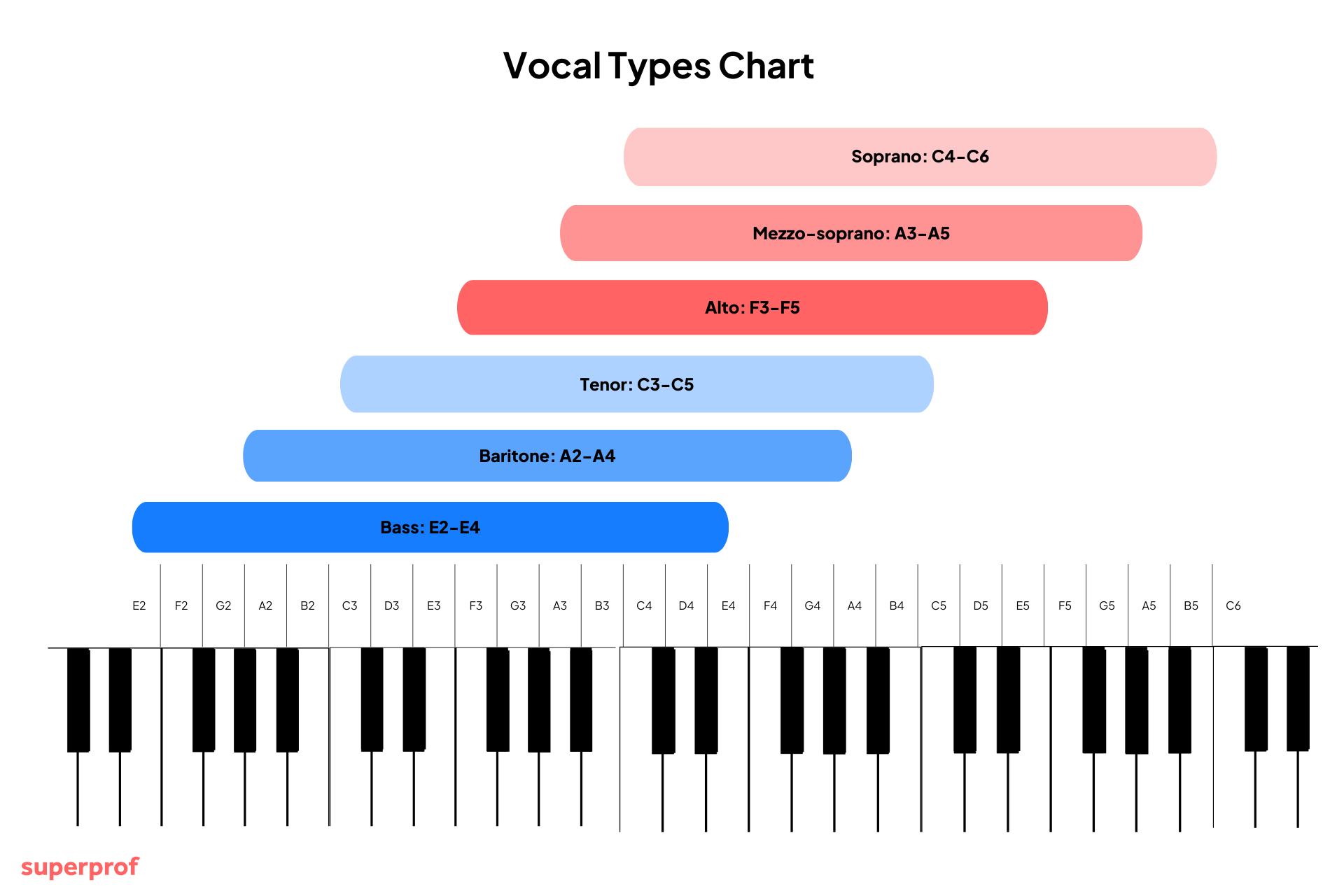
Vocal classification reflects the texture, weight, and comfort zone of a singer’s voice. From the soaring notes of sopranos to the resonant depth of basses, each vocal type offers unique qualities that shape the way singers perform and connect with music. Below is a breakdown of common vocal types along with notable singers who exemplify them.
| Voice type | Typical range | Famous singers |
|---|---|---|
| Soprano | C4 – C6 (or higher) | Mariah Carey, Ariana Grande, Minnie Riperton, Georgia Brown, Yma Sumac, Maria Callas |
| Mezzo-soprano | A3 – A5 | Whitney Houston, Beyoncé, Christina Aguilera, Adele, Sia, Pat Benatar |
| Contralto | E3 – E5 | Tina Turner, Rachelle Ferrell, Cher, Tracy Chapman, Nina Simone |
| Tenor | C3 – C5 | Freddie Mercury, Adam Lambert, Steve Perry, Prince, Jonas Kaufmann |
| Baritone | A2 – A4 | Elvis Presley, Ville Valo, Josh Groban, Mike Patton, Bob Dylan |
| Bass | E2 – E4 (or lower) | Tim Storms, Tim Foust, Barry White, Johnny Cash |
| Countertenor | G3 – D6 | Dimash Kudaibergen, Adam Lopez, Vitas, Andreas Scholl |
So now that we've explored vocal range and vocal types, let's take a closer look at some of the greatest singers and how their unique vocal abilities have set them apart.
The Record Holders
Tim Storms — 10 octaves
Tim Storms holds two Guinness World Records: the widest vocal range and the lowest note produced by a human1. His range spans ten octaves, from G−7 to G5.
The lower reaches of that range are, strictly speaking, inaudible — his record-setting low note sits far below the roughly 20 Hz threshold of human hearing, and can be measured instrumentally but not heard. Storms works primarily in choral, gospel and commercial recording rather than pop, and contributed vocals to exhibition soundtracks including Titanic: The Exhibition.
Georgia Brown — 8 octaves
The Brazilian singer Georgia Brown holds the Guinness record for the widest vocal range by a female singer: eight octaves, G2 to G10, verified in the early 2000s at the Aqui Jazz Atelier Music School2.
As with Storms, the extremes sit outside ordinary hearing. G10 corresponds to roughly 25,000 Hz — above the accepted upper limit of human hearing, at about 20,000 Hz — so the top of the range is better understood as a measured achievement than a musical one.
Adam Lopez — 6 octaves
The Australian countertenor Adam Lopez previously held the Guinness record for the highest note sung by a male, reaching into the eighth octave. His working range spans roughly six octaves from E2.
What is the highest note ever sung?
The highest note recognised by Guinness World Records is G10, sung by Georgia Brown — approximately 25,000 Hz, more than six octaves above middle C. Among male singers, Adam Lopez holds the record for the highest note sung by a man, in the eighth octave.
Among commercially released pop recordings, the highest notes you can actually go and listen to are Mariah Carey's G♯7 and Minnie Riperton's F♯7, the latter heard in "Lovin' You" (1975).
Female Singers With the Widest Vocal Range
| Singer | Octaves | Range | Voice type |
|---|---|---|---|
| Georgia Brown | 8 | G2 – G10 | Soprano |
| Mariah Carey | 5 | G♯2 – G♯7 | Coloratura soprano |
| Yma Sumac | ~4.3 | B2 – C♯7 | Soprano |
| Minnie Riperton | ~4.3 | D3 – F♯7 | Soprano |
| Christina Aguilera | ~4 | C3 – C♯7 | Mezzo-soprano |
| Ariana Grande | ~4 | D3 – E7 | Soprano |
| Chanté Moore | ~4 | D3 – D7 | Soprano |
| Deniece Williams | ~4 | C3 – C7 | Soprano |
| Rachelle Ferrell | ~4 | G2 – G6 | Contralto |
Mariah Carey
🎵 Vocal Range:
G#2 to E7 (5 octaves)
🎤 Voice Type:
Soprano
⭐️ Known for: Vocal agility, intricate vocal embellishments
Mariah Carey Octave Range
How many octaves can Mariah Carey sing? You'd be hard-pressed to find a singer who can surpass Mariah Carey's vocal range. Mariah Carey can sing a stunning five octaves, including notes from G#2 to E7, with some sources claiming she can reach even beyond that.
Mariah’s five-octave vocal range allows her to move seamlessly from rich, deep low notes to astonishingly high whistle tones—a vocal register so rare and piercing that few singers can access it. She uses this technique not just for show, but musically and melodically, incorporating it into her melodies and improvisations. Aspiring vocalists often seek singing lessons to develop similar innovative techniques.
Her whistle register has become a signature element of her music, often compared to the sound of a flute or bird song. She uses this technique not just for show, but musically and melodically, incorporating it into her melodies and improvisations.
You can hear her hit E7 in her song "Emotions".
Learn more about how to increase your vocal range.
Whitney Houston
Whitney Houston is a legendary singer whose voice still resonates with audiences today. Her remarkable ability to effortlessly navigate through octaves showcased her immense talent and set her apart as an exceptional vocalist. Houston's vocal range spanned approximately three octaves, allowing her to explore the depths of her lower register with a velvety warmth while effortlessly soaring to the highest notes with incredible clarity and precision.
Enhance your breathing control and vocal projection with the expert guidance of singing lessons.
Whitney Houston Vocal Range
Whitney Houston had a vocal range of approximately five octaves, though most sources commonly cite 3 octaves and a couple of notes, roughly from C3 to C6, with some excursions beyond that in live performances and studio recordings.
Here’s a breakdown:
Lowest note: Around C3 (one octave below middle C)
Highest recorded note: Around G#6 in live performances (whistle register not frequently used)
Most comfortable range: Her most iconic performances sit solidly in the mezzo-soprano to dramatic soprano territory.
She was known more for her tone, control, and emotional delivery than for extreme vocal acrobatics, though she certainly had power and flexibility when needed.
What truly distinguished Houston was her ability to effortlessly reach into the whistle register, a rare and impressive feat. This uppermost range showcased her extraordinary control and agility, captivating listeners with her ability to hit and sustain unbelievably high notes. Her vocal prowess solidified her status as one of the greatest singers ever, impacting the music industry. Many aspiring artists enhance their technique by taking singing lessons.
Georgia Brown
The last artist on our short list is perhaps not as well known as some of the other singers on this list, however, she has the widest vocal range, with an astonishing 8 octaves. Georgia Brown, a Brazilian singer, is renowned for her ability to hit notes in the whistle register with ease, a rare vocal feat that adds to her unique singing capabilities.
Georgia Brown's music includes elements of pop, soul, and R&B, showcasing her ability to adapt her voice to different genres. Notable songs that highlight her vocal range and skill include "Love Medley," where she demonstrates both her lower and higher registers with remarkable control and precision. Enthusiasts looking to broaden their dynamic range might consider singing lessons.
Minnie Riperton
Minnie Riperton was an American singer-songwriter best known for her 1975 single "Lovin' You" and had a stunning four-octave range from D3 to F♯7. Minnie was trained as a singer, actor and dancer at Chicago's Abraham Lincoln Centre.
The song has had something of a revival now that it has become trendy to use as audio on TikTok.
Sometimes called "Queen of the Whistle Register" in the media, she recorded six albums in her ten years as an active singer. Riperton sadly died of breast cancer in 1979 at the age of 31.
Singing lessons provide personalised guidance, tailored to your unique strengths and areas for improvement.
Ariana Grande
Ariana Grande Vocal Range
Ariana Grande possesses an impressive vocal range that spans approximately four octaves, from D3 to E7. Known for her agile soprano voice, she seamlessly transitions between powerful belts, soft falsettos, and her signature whistle register. Grande's range, control, and versatility have made her one of the most technically gifted pop vocalists of her generation.
Most recently, Grande showcased her theatrical roots and classical training as Glinda in the 2024 film adaptation of Wicked, earning widespread critical acclaim for her performance. The role allowed her to demonstrate her musical theatre prowess alongside her pop sensibilities, proving her ability to navigate both contemporary and Broadway styles with equal finesse.
Remember when we were talking about the whistle register earlier? Ariana's ability to execute complex vocal runs and hit high notes with clarity has drawn comparisons to Mariah Carey, particularly in songs like “Emotions” and “Into You.”
Beyonce
Beyoncé has a vocal range that spans approximately three to four octaves, from G#2 to E6, showcasing impressive versatility across multiple genres, including R&B, pop, soul, and hip-hop. While she may not reach the whistle register like Mariah Carey, Beyoncé is renowned for her powerful mezzo-soprano voice, which combines strength, control, and emotional depth.
Beyoncé has earned 35 Grammy Awards, making her the most awarded artist in Grammy history, and she’s received numerous other accolades including MTV VMAs, BET Awards, and Billboard honours. Known for her fierce independence and visual artistry, she has also released groundbreaking visual albums like Lemonade and Black Is King, further solidifying her status as a cultural icon. Such dynamic performances inspire many to take singing lessons to improve vocal control.
Cynthia Erivo
Cynthia Erivo is a British singer, actress, and Broadway star known for her powerful soprano voice, emotional depth, and commanding stage presence. With a vocal range spanning approximately three octaves, she blends classical technique with soul and gospel influences, delivering standout performances in both musical theatre and film.
Cynthia Erivo is classified as a lyric soprano with mezzo-soprano qualities, known for her rich, warm lower register, agile midrange, and powerful, resonant upper register. She brings remarkable emotional depth and technical control to her performances, often blending classical technique with contemporary soul and gospel influences.
Taylor Swift
Taylor Swift is celebrated for her versatile vocal abilities and emotive delivery, which have evolved significantly throughout her career. Starting in country-pop, she has seamlessly transitioned into pop, indie, and alternative genres, showcasing a vocal range that spans approximately 3.6 octaves. Her mezzo-soprano voice allows her to navigate both rich low notes and bright, soaring highs, giving her performances a dynamic and expressive quality.
Taylor Swift’s vocal range of A2 to E6 is showcased across many of her songs. In her lower register, tracks like “All Too Well (10-Minute Version)” highlight her rich, resonant lows. Her mid-range is prominent in hits like “Love Story” and “You Belong With Me”, where she blends warmth with clarity. In her upper register, songs such as “Enchanted” and “Wildest Dreams” demonstrate her bright, soaring high notes, often using head voice to convey vulnerability and emotional intensity.
Swift’s singing is characterised by a breathy, intimate timbre that conveys vulnerability and emotion. She frequently uses her head and mixed voice to create contrast and depth, making her songs feel personal and relatable. Over the years, her vocal development has been widely praised, with albums like Folklore and Evermore highlighting her tonal clarity and versatility, solidifying her status as one of the most influential vocalists of her generation.
Chanté Moore
Chanté Moore's incredible, four-octave range voice has always set the atmosphere and gets the crowd screaming with sweet melodies.
She released her first album, Precious, in 1992 and has since been heard on the radio and seen on television. She has also written books and acted—a true multi-talent, in other words.
Yma Sumac
Originally from Peru, she was named Zoila Augusta Emperatriz Chávarri del Castillo. She took Yma Sumac based on her mother's name, which derived from Ima Shumaq, Quechua, for "how beautiful!".
In 1951, Sumac became the first Latin American singer to debut on Broadway. Her shows on Broadway sold more than 20 thousand tickets, and she has sold more than 40 thousand albums.
One source claims that when she sang the song "K'arawi", she reached D8. If true, this will extend her vocal range to over five octaves, perhaps even six.
Adele
Adele, the British singer-songwriter, is celebrated for her rich and soulful contralto voice, which spans three octaves from B2 to D6. Her vocal delivery is characterised by its depth and emotive power, allowing her to convey profound emotion in her music. Known for her powerful belting and heartfelt ballads, Adele's voice resonates with a broad audience, touching on themes of love, heartbreak, and self-reflection. Her ability to connect with listeners through her vocal intensity and lyrical honesty has earned her critical acclaim and numerous awards, including multiple Grammy Awards.
Many aspiring artists enhance their technique by taking singing lessons.
Rihanna
Rihanna is a mezzo-soprano whose range extends from B2 to C♯6 while recording tracks for her third studio album, Good Girl Gone Bad (2007). Her vocal performance on Loud (2010) received positive reviews from music critics. Growing up in Barbados, she listened mainly to reggae, hip hop and soca music. When she came to the United States, she was exposed to different types of music, including rock, and I fell in love with it.
Julie Andrews
Julie Andrews is a British singer and actress whose crystalline soprano voice and flawless vocal technique made her one of the most beloved performers of the 20th century. With a vocal range spanning approximately three octaves in her prime, she combined classical training with effortless charm, delivering performances that defined the golden age of musical cinema.
She achieved international stardom with her Oscar-winning role as Mary Poppins and cemented her legendary status as Maria von Trapp in The Sound of Music, one of the highest-grossing films of all time. She is classified as a soprano with exceptional clarity and purity of tone, particularly known for her brilliant upper register, precise vocal control, and distinctive "bell-like" quality.
Grimes
Claire Elise Boucher, born 17 March 1988 in Vancouver, better known by her stage name Grimes, is a Canadian musician, singer, songwriter and music producer. Grimes' music has been described by several labels, including synthpop, electropop and lo-fi, with elements of hip-hop and R&B. Grimes is known for her eclectic and futuristic sound, which blends elements of experimental music to create a unique musical style that pushes the boundaries of contemporary music.
Kate Bush
Ethereal high notes, theatrical delivery and expressive storytelling
Few artists blend theatricality and technical skill quite like Kate Bush. Known for her ethereal tone and experimental style, she is widely considered a soprano with an unusually flexible and expressive range. Across her recordings, her voice spans roughly 3 to 3.5 octaves (around G♯2 to B5), though some analyses suggest she can stretch even further depending on technique and era.
What makes Bush stand out isn’t just the raw range—it’s how she uses it. Early in her career, tracks like Wuthering Heights showcased her ability to sustain high, piercing notes in the upper register, often sitting comfortably in the fifth octave for extended passages. Later work revealed a richer lower register, demonstrating impressive control across her full range.
Rachelle Ferell
Rachelle Stephanie Ferrell is an American singer and musician. Although she has had some success in the R&B, pop, gospel and classical scenes, she is best known for her contemporary jazz singing. Ferrell began singing at six and has developed a six-octave range by the time she is an adult. She is also able to sing in the whistling range.
Laura Branigan
Laura Branigan was an American singer and songwriter known for her powerful vocals and her hit songs in the 1980s. She was born on July 3, 1952, in Brewster, New York, and began her musical career in the 1970s, primarily as a session singer and backing vocalist for various artists. Branigan's breakthrough came in 1982 with the release of her debut single "Gloria," which became an international hit. Laura Branigan's voice extends over four octaves, and her music blended pop, rock, and dance elements, often incorporating synthesisers and catchy melodies.
Christina Aguilera
With a range of four octaves, Christina Aguilera never ceases to amaze. Renowned for her powerful voice and vocal range, she's made a significant impact on pop and R&B music of the 90s with her soulful performances and ability to seamlessly transition between genres. While famous for her hits, we tend to forget how powerful and incredible her voice is, which more than earns her a place on this humble list.
Unlock your hidden potential with the help of a voice coach here on Superprof.
Annie Haslam
Annie Haslam is an English singer and songwriter, best known as the lead vocalist of the progressive rock band Renaissance. She was born on June 8, 1947, in Bolton, Lancashire, England. Haslam's career in music began in the late 1960s when she joined the band "The Dowling Poole" and subsequently worked with various groups and artists, including Mike d'Abo and David Byron. Haslam's soaring and ethereal vocals, which extend over five octaves, often accompanied by orchestral arrangements, became one of the trademarks of Renaissance's music.
Maria Callas
Maria Callas was a singer whose vocal range spanned three octaves. As a dramatic soprano,her perfect high notes served her well. She started her career aged 17, singing in a deep, mixed, and high register, the one we're focusing on today. This allowed Maria Callas to sing almost anything, and her voice was compared to the cello, violin, and flute. Her voice was exceptional.
Céline Dion
With a range of four octaves, Céline Dion made herself known as one of the world's greatest singers. Sometimes nasal, sometimes stunning, this superstar singer will always hit the high notes whether she's singing in French or English! Céline is credited for introducing French-language music to many people worldwide, and her cultural impact has earned her musical and political accolades in Canada and worldwide.
Find singing classes London here on Superprof.
Sia
Sia Furler is an Australian singer-songwriter known for her distinctively powerful and emotionally raw vocal style. With a vocal range spanning approximately three and a half octaves, she combines technical prowess with unfiltered emotional expression, creating intense and cathartic performances that have made her one of pop music's most distinctive voices.
She gained international recognition with hits like "Chandelier," where her soaring, urgent vocal delivery became iconic. Sia is celebrated for her ability to belt with extraordinary power and sustain, often employing a throaty, almost shouted quality that conveys vulnerability and strength simultaneously. Her unconventional approach to pop vocals—favouring raw emotion over polish—has influenced a generation of singers and redefined what mainstream pop singing can sound like.
Nina Simone
Simone trained as a classical pianist and approached singing as an extension of that discipline — her phrasing is architectural, and she almost never decorates a line. The voice itself is a genuine contralto, unusually low and unusually plain, with a grain that deepened across her career. That refusal to embellish is precisely what gives "Feeling Good" and "Sinnerman" their force.
Tina Turner
Rock singer Tina Turner broke through as a solo artist in the 80s with hits like "What's Love Got to Do with It". Tina Turner is one of the biggest stars in rock history. She has been internationally loved and recognised for decades with smash hits like The Best, What's Love Got to Do with It and the Bond theme song Goldeneye.
Tina Turner's exceptional control allows her to create varying sounds and tones, giving her great versatility that will enable her to adapt to many different musical genres. Her unique technique ultimately led to her singing well into her seventies. Tina Turner exhibits comfort with second-octave notes, which she reaches seemingly effortlessly.
Bonnie Tyler
The Welsh singer's famous husky rasp was not a stylistic choice but the result of surgery on vocal nodules in the mid-1970s, after which her voice returned deeper and grainier than before. She built a career on it. "Total Eclipse of the Heart" remains one of the most demanding vocal performances in mainstream pop — a sustained, escalating delivery that few singers attempt live. Tyler has recorded in five decades.
Barbra Streisand
Streisand's voice is a study in technical ease. She has said she rarely warms up before performing, and the quality most often noted by other singers is her legato — the seamless connection between notes that makes difficult intervals sound conversational. Her range is wide but her real signature is interpretation: an ability to phrase a lyric so that its meaning shifts. She is one of a handful of EGOT winners.
Annie Lennox
Lennox's contralto is cool where most powerful voices are warm — a deliberate restraint that made Eurythmics' synth-driven arrangements sound human rather than clinical. She trained at the Royal Academy of Music before leaving to form the band, and the classical grounding shows in her breath control and the evenness of her tone across registers.
Cher
Cher's voice sits unusually low for a female pop singer, and that has been the constant across sixty years of shifting styles — folk-rock, disco, power ballad, dance. "Believe" (1998) is also the record that introduced hard-tuned vocal processing to mainstream pop, an effect deliberately chosen rather than corrective.
Male Singers With The Widest Vocal Range
| Singer | Octaves | Range | Voice type |
|---|---|---|---|
| Tim Storms | 10 | G−7 – G5 | Bass |
| Adam Lopez | 6 | E2 – E♭8 | Countertenor |
| Dimash Kudaibergen | ~6 | C2 – D8 | Tenor |
| Axl Rose | ~5.4 | F1 – B♭6 | Tenor |
| Mike Patton | ~5 | E1 – E6 | Baritone |
| Vitas | ~5 | G2 – G7 | Countertenor |
| Ville Valo | ~5 | C2 – C7 | Baritone |
| Tim Foust | ~5 | E1 – E6 | Bass |
| Freddie Mercury | ~4 | F2 – F6 | Tenor |
| Prince | ~4 | B2 – B6 | High tenor |
| Steven Tyler | ~4 | D2 – E6 | Tenor |
Freddie Mercury
Freddie's impressive vocal range went from a bass low F (F2) to soprano high F (F6) and he could belt up to F5. His extraordinary vocal range allowed him to navigate through various musical styles and genres effortlessly. His voice was a versatile instrument, reaching both high and low notes with incredible precision and control. Few can match the charisma and vocal prowess of Freddie Mercury when it comes to legendary musicians.
Freddie Mercury's vocal range spanned an impressive four octaves. While Freddie Mercury's entire vocal range was awe-inspiring, one note, in particular, stands out as an astonishing feat. In the song "The Show Must Go On," Freddie reaches an incredibly high note known as a B5. This note is notoriously tricky to get for most singers, but Freddie Mercury effortlessly hits it with remarkable power and accuracy, showcasing his exceptional vocal abilities.
Developing your vocal prowess through singing lessons enables you to tackle a diverse range of music genres and styles.
Tim Storms
When it comes to vocal range, few singers have pushed the boundaries of what the human voice can do quite like Tim Storms. Hailing from the United States, Storms holds not one but two Guinness World Records: one for the lowest note ever produced by a human and another for the widest vocal range—an astonishing 10 octaves.
Though he’s not a household name in the pop world, Storms is a sought-after performer for choral groups, gospel ensembles, and commercial projects needing extreme bass tones. Aspiring vocalists often find that singing lessons can further refine their unique vocal capabilities. One of his standout contributions includes vocal work for soundtracks and exhibitions, including The Titanic: The Exhibition, where he performed background vocals designed to evoke the depths of the ocean.
Vitas
Vitas is a Russian-Ukrainian artist with an impressive 7-octave vocal range. He became best known in the world through the song The 7th Element, which went viral on YouTube a couple of years ago. I'm willing to bet you recognise him in the clip below.
After being rejected from the music school in his home town of Odesa, his family could not afford to send him to a public school. Vitas, who was already using his name as a pseudonym, began performing in nightclubs. He began his career paying tribute to Michael Jackson but has also performed parodies and his own songs.
His breakthrough came when Vitas and his girlfriend filmed a video clip for "Opera #2", in which Vitas plays an eccentric lone man with fish gills, who lives in a bathtub with fish jars and plays the accordion naked. The clip was first broadcast in December 2000 and generated a lot of interest. Vitas began performing the song with artificial gills, prompting the Russian media to compare him to Ichthyander, a character from the novel The Amphibious Man.
Adam Lambert
Adam Mitchel Lambert is an actor and singer-songwriter from San Diego, California, USA. He began performing in musicals at ten but came to prominence in May 2009 when he placed second on the eighth season of American Idol.
Adam Lambert's vocal range is an impressive three-octave (B2-B5). He's known for his expert vibrato and dynamic, piercing, robust falsetto singing, which allows him to stretch into the fifth octave.
Luciano Pavarotti
Luciano Pavarotti was renowned for his ease in reaching high notes—with a vocal range spanning an impressive 3,5 octaves (C#3 to F5). As one of the most renowned Italian tenors who died in 2007, he certainly deserves his place on this list.
Did you know that he never went anywhere without his scarf? This was to keep his neck warm when he wasn't singing on stage. In 1990, the tenor lost his favourite red silk scarf in Florence and issued a plea in local media for it to be returned to the theatre in the city.
Find out how to hit the lower notes.
Jonas Kaufmann
The German opera singer Jonas Kaufmann is one of the most impressive male voices.
Jonas Kaufmann is a tenor, technically speaking. However, his voice has many nuances, and his 2-octave vocal range (C2-B4) also covers a large part of a baritone while also being able to hit those high notes. While he's a natural tenor, he's also so much more.
Jonas Kaufmann sings high C's in La Boheme. Some of his standout roles include Don José in Carmen, Don Alvaro in La Forza del Destino, Siegmund in Die Walküre, Cavaradossi in Tosca, Maurizio in Adriana Lecouvreur, and the title roles in Werther,Parsifal, Don Carlos, and Lohengrin.
Find out how to hit the higher notes.
Steve Perry
Steve Perry is renowned for his impressive vocal range, spanning nearly three octaves (B2-B5), which allows him to move between rich low tones and soaring high notes effortlessly.
Beyond his technical skills, Perry’s songwriting and distinctive voice helped Journey achieve international fame, with many of their songs becoming anthems of the rock genre. Even decades after his peak, his influence remains strong, and his voice continues to be celebrated by fans and musicians alike.
Elvis
Elvis Presley was an American singer known as the "King of Rock and Roll," whose rich baritone voice and charismatic delivery transformed popular music. With a vocal range spanning approximately three octaves, from E2 to C6, he effortlessly moved between genres, including rock, gospel, blues, and ballads, showcasing remarkable versatility and emotional expression.
He rose to prominence in the mid-1950s, revolutionising music with his unique blend of rhythm and blues, country, and pop. Elvis is celebrated for his warm, resonant tone, distinctive vibrato, and ability to convey both raw power and tender vulnerability. His influence on rock and roll, gospel music, and popular culture remains unmatched.
Steven Tyler
Steven Tyler, often referred to as the "Demon of Screaming," is the dynamic frontman of the legendary rock band Aerosmith.
Known for his distinctive high-pitched screams and gritty vocal delivery, Tyler's vocal range spans an impressive D2 to E6. Tyler's signature sound has been a driving force behind Aerosmith's enduring success, with timeless hits like "Dream On," "Sweet Emotion," and "I Don't Want to Miss a Thing." For aspiring vocalists on the south coast, singing lessons Brighton can help build safe technique for powerful high notes.
Prince
Prince is another singer whose voice spans more than four octaves. His voice and tessitura overlapped with female voices, but Prince's voice was exceptionally high and flexible simultaneously. Of course, Prince was more than just an incredible singer who could play various musical instruments and wrote an impressive amount of excellent music.
Dimash Qudaibergen
This artist from Kazakhstan is a singer, songwriter, and multi-instrumentalist. He has a university degree in both modern and classical music. He became known through the Chinese competition programme Singer 2017, where he finished second. His popularity is partly due to his wide vocal range, which spans 6 octaves (A1-D8). Despite being offered a place at the Astana Opera, he focused on modern music instead.
Check out our tips for singing high notes.
Axl Rose
If one person breaks the mould, it must be Axl Rose. The lead singer of the American rock group Guns N' Roses, Axl Rose, has a vocal range of five and a half octaves. This allows him to sing as high as many female singers and as low as most male singers.
This range allowed Axl Rose to play an essential role in his music. If you're looking for singing inspiration, look no further than Axl Rose.
Michael Jackson
Jackson's range is often discussed and rarely measured carefully, partly because his most distinctive qualities aren't range at all — they're rhythm, articulation and an unmatched instinct for where a syllable should land. His voice deepened considerably from the Jackson 5 years into adulthood while retaining full access to a light, agile falsetto. He also famously vocalised basslines, drum parts and string arrangements for his producers.
Bob Dylan
Bob Dylan is an American singer-songwriter whose unconventional voice and profound lyricism revolutionised popular music. He rose to prominence in the 1960s as the voice of a generation, blending folk, rock, and blues while addressing civil rights, war, and the human condition. Dylan is celebrated for his nasally, weathered vocal quality, conversational phrasing, and willingness to prioritise authenticity over polish.
He won the Nobel Prize in Literature in 2016, recognising his profound influence on culture and his creation of "new poetic expressions within the great American song tradition." Bob Dylan is classified as a baritone with a highly distinctive, gravelly quality that has evolved significantly throughout his six-decade career, proving that vocal greatness isn't measured solely by range or technique, but by the power to move, inspire, and provoke thought through song.
Mike Patton
Mike Patton is an American musician and songwriter from the United States. He is best known as the lead singer of the band Faith No More since 1988, but he has also been the lead singer for bands such as Mr Bungle, Tomahawk and Fantômas. Patton's signature is his experimental nature and advanced vocal technique. Patton is stated to have a vocal range of six octaves.
Bobby Hatfield
Bobby Hatfield, best known as one half of The Righteous Brothers, possessed a remarkable tenor voice that was both soulful and powerful, complementing the duo's signature blend of blue-eyed soul and classic pop ballads.
The Righteous Brothers continued their rise to fame despite what appeared to be a setback in their career when they left their role as support act on the Beatles' US tour in August 1964 after finding it impossible to perform in the face of screaming Beatles fans. They immediately returned to Los Angeles to become regulars on the TV show Shindig! They built up a solid reputation for their frenetic rock'n'roll acts. If you're based in North Yorkshire, singing lessons York can help you develop stamina and technique for demanding live performances.
Frank Sinatra
Sinatra's range is modest and entirely beside the point. What he had instead was breath — he studied the bandleader Tommy Dorsey's trombone breathing to learn how to carry a phrase across bar lines without an audible break — and an instinct for singing lyrics as though speaking them. Almost every popular vocalist since has borrowed from his phrasing, whether they know it or not.
David Bowie
Bowie's natural voice was a warm English baritone, but he treated it as a costume — the crooner of "Wild Is the Wind," the strained rock tenor of "Heroes," the clipped soul singer of Young Americans barely sound like the same performer. The technical range is respectable; the expressive range is close to unmatched in popular music.
Johnny Cash
Cash is the clearest argument in this article that range and greatness are unrelated. His compass was roughly two octaves and narrowed with age, yet his late recordings — particularly the 2002 cover of "Hurt" — are among the most affecting vocal performances ever committed to tape. The instrument was worn; the authority was absolute.
Neil Sedaka
Neil Sedaka’s voice is a textbook example of a light lyric tenor, with a bright, youthful tone that defined much of early 1960s pop. His ability to move comfortably into the upper fifth octave gave his songs a buoyant, almost playful quality, while still maintaining precision and clarity. Unlike more forceful tenor voices, Sedaka’s strength lies in control and consistency rather than sheer power.
What sets him apart is his ease in the upper register, often reaching high notes without strain or dramatic shifts in tone. This smooth transition between registers allows his melodies to feel fluid and accessible, contributing to the timeless appeal of his recordings.
Michael McDonald
McDonald's baritone is one of the most imitated voices in American music — a warm, grainy instrument with a slight catch that turned The Doobie Brothers from a rock band into a soul act. His upper register carries an unusual amount of weight for a baritone, which is why his choruses sit so high without ever sounding thin. "What a Fool Believes" won Song of the Year at the 1980 Grammys.
Peter Steele
The late Type O Negative frontman possessed one of the lowest natural voices in popular music — a sepulchral bass-baritone that sat beneath almost every other rock singer of his era and gave the band its distinctive funereal weight. Steele used the extremes deliberately, dropping into near-spoken sub-bass for dramatic effect and lifting into a surprisingly melodic upper register on tracks like "Love You to Death." He died in 2010, aged 48.
Enrico Caruso
Caruso is the reason opera reached a mass audience. His voice combined the brightness of a tenor with a baritone's darkness and heft in the lower register, and it happened to record unusually well on the primitive acoustic equipment of the early 1900s — his "Vesti la giubba" is often described as the first record to sell a million copies. He died in 1921 at 48, having made around 250 recordings.
Miljenko Matijevic
The Steelheart frontman has one of the highest sustained rock registers ever committed to record. "She's Gone" (1990) is the standard demonstration — a performance so demanding that it has become a benchmark on singing competition shows across Asia and Eastern Europe, where the song enjoys a second life. Croatian-born and raised in the United States, Matijevic also provided the singing voice for the film Rock Star.
Frankie Valli
Valli built The Four Seasons around a single technical asset: a falsetto so strong and so precisely pitched that it functioned as a lead instrument rather than an ornament. Where most singers use falsetto for softness, Valli used it for penetration — the hook of "Sherry" cuts through an arrangement in a way a chest voice could not. He later demonstrated the full weight of his natural tenor on "Can't Take My Eyes Off You."
Morten Harket
The a-ha frontman is responsible for one of the most recognisable high notes in pop: the falsetto leap in the chorus of "Take On Me," a note that has defeated karaoke singers for four decades. Harket's real distinction is control rather than reach — his upper register is unusually pure and sustained, with none of the strain that normally accompanies notes at that height. He has continued performing into his sixties.
Josh Groban
Josh Groban is an American singer known for his rich baritone voice and ability to bridge classical and contemporary pop music. With a vocal range spanning approximately three octaves, he combines operatic technique with accessible pop sensibilities, creating a distinctive sound that has made him one of the best-selling artists in the classical crossover genre. He rose to prominence in the early 2000s with his self-titled debut album and cemented his status with multi-platinum releases featuring powerful ballads sung in multiple languages.
Charlie Puth
Puth is one of the few working pop singers with documented perfect pitch — the ability to identify or produce any note without a reference. For a singer, it's less a party trick than a working tool: he never has to find his starting note, only sing it. The voice itself is a light tenor with an unusually secure falsetto, which he treats as a melodic register rather than decoration — "We Don't Talk Anymore" sits almost entirely in it.
More Remarkable Voices
The singers above are the ones most often named when vocal range comes up, but they're far from the whole story. Range turns up in places the usual lists overlook — in heavy metal, where the genre's demands have produced some of the most extreme registers in recorded music; in early opera recordings; and in the deep bass voices that anchor soul and country.
The singers below extend the chart into that territory. Some reach higher or lower than names in the main table.
| Singer | Octaves | Range | Voice Type | Hear It On |
|---|---|---|---|---|
| Rob Halford | ~4 | F2 – C6 | Tenor | Painkiller |
| Geoff Tate | ~4 | F2 – F6 | Tenor | Silent Lucidity |
| Corey Taylor | ~4 | E2 – E6 | Baritone | Duality |
| Devin Townsend | ~4 | C2 – B♭6 | Baritone | Kingdom |
| Yannis Papadopoulos | ~4 | E2 – E6 | Tenor | Blind and Frozen |
| Nicole Scherzinger | ~3.5 | F♯2 – C♯6 | Mezzo-soprano | As If We Never Said Goodbye |
| Bruce Dickinson | ~3.5 | G2 – C6 | Tenor | The Number of the Beast |
| Layne Staley | ~3.5 | G♯2 – D6 | Baritone | Man in the Box |
| David Lee Roth | ~3.5 | A2 – A5 | Tenor | Runnin' with the Devil |
| Zhou Shen | ~3.5 | F3 – C7 | Countertenor | Big Fish |
| Dan Vasc | ~3.5 | F2 – C6 | Tenor | The Sound of Silence |
| Tommy Johansson | ~3.5 | G2 – D6 | Tenor | ReinXeed recordings |
| Barry White | ~2.5 | E1 – A3 | Bass | Can't Get Enough of Your Love, Babe |
👇Who are your favourite singers? Which would you have included on this list?Let us know in the comments below!
In your opinion, who is the best singer of all time? 🎤
If you want to learn more about singing, expanding your vocal range, or music theory, consider contacting one of the many talented and experienced private singing tutors on the Superprof website.
For those seeking focused, personalised guidance, singing lessons in Leeds offer specialised instruction.
References
- Guinness World Records — Greatest vocal range by a male (Tim Storms). https://www.guinnessworldrecords.com/world-records/greatest-vocal-range-male
om - Guinness World Records — Greatest vocal range of a person (female) (Georgia Brown). https://www.guinnessworldrecords.com/world-records/greatest-vocal-range-female
Summarise with AI:
Did you like this article? Leave a rating!

 Loading...